Planning the Big Getaway

As I dive deeply into the planning of my spring trip, I wanted to share this post with you again.  What starts as an idea, gets put on paper as a spreadsheet of possibles, is inked in with travel times, ultimately becomes the dream and adventure!  I hope you find something here helpful as you plan your next big getaway.

***************

It usually starts on a rainy afternoon for me – that moment when I know it’s time.  All the ideas that have flitted through my mind, all the reviews from the travel section, all the Pinterest posts, begin to swim to the surface and demand attention.

Wrinkle-free clothes look chic (add a scarf and the right jewelry and you could wear it 7 times…)

Travel-size products are everywhere.

Luggage stores are fascinating.

But, once you decide to take the trip, to just do it, how do you start to put it all together?  For me, it all starts with a spreadsheet. Really.

In business school, we would start a financial model for an idea with a blank spreadsheet.  This was tough for some folks to do.  You’d hear the question, “But, aren’t you just making it up?”  Well, yes.   In the end, we all learned to take that empty spreadsheet, create some basic assumptions, identify some facts and decide the desired outcomes.  Then, we began building a picture.

It was never “right” at the beginning but by creating a rough picture we could start changing the pieces, shifting the variables. Pretty soon, we had a working model whose outcomes would change as we turned the dials a bit.  It was just getting started that felt hard.

This idea that I learned in school doing case studies of imaginary widget factories (with decreasing utility for said widgets while widget raw materials costs increased) actually works for me for trip planning. For you, it might be a dream board, a flow chart or a set of post-its.

What matters is asking the question: What are the basic blocks?  This is a018_18 great way to distill your your big technicolor travel dream into parts and start to prioritize the pieces.  The center of your dream could be a place, an event, or a season. I wanted to see the spring flowers bloom along the Seine in Paris, preferably from a boat, admittedly wearing my new yellow trench coat.  There just isn’t much opportunity for a yellow trench in Tennessee, but in Paris?
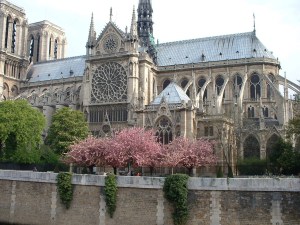
After scouring web sites to define the range for “spring”, I thought about what I wanted to trip to be like.  I’d love to see the full moon on the Seine so which weeks during  March, April or May would have a full moon?  Then during those weeks, was there a concert, festival or other event I’d like to see?  Any major events going on whose crowds I’d like to avoid?

This gives my trip a shape — once I put in the date range that gets me where I want to be,  but still with wiggle room, it’s a great time to look for good airfares. Can I leave 2 days earlier or come back a day later?  Then, I decide the top three or four experiences that the keys to my big technicolor dream trip.   Sometimes this causes a shift within the trip …if I only have a week, the days the  museums are closed in one city or the night tickets are available for an opera in another can shift the days within the master plan but no problem.  It’s all in context.

Once I have an arrival and a departure, and a few major activities, I start to have fun. There is enough structure to see the trip as “real” and start working on the details and extras.  Then I begin to write the travel brochure for my big adventure.

Here’s one thing I quit doing. Until recently, I planned out every day charting out what I would see, where I would go, how I would get there. Every morning I pulled out my marching orders from home and struck out.

Then it hit me.  Travelling on my own demanded more. I wanted to learn to choose what I wanted to do each day, on that day, to intentionally listen to my own heart and to take opportunities and to be brave.

My “home self”, the self sitting in PJ’s months earlier surrounded by travel books was as stern a taskmaster as a professional tour director insisting I only had 15 minutes for the Louvre. I had become my own dictator. I wasn’t really living in that moment.

Now I just have the non-negotiables charted (and this gives me a bit of confidence) and work from a list of possibilities that I pull out from time to time.  Doing what you most want to do on any particular day is more difficult than you might think but worth the experience. Shuffling off the coils of what I should do, what friends suggested, what Rick Steves would do, to follow my own path is the goal for me.

What I Learned

  1. Just start. Create a spreadsheet or chart for the number of days you have and start filling in the blocks. (Remember to check travel times and train schedules).
  2. Pay special attention to the three or four things that are key to your trip – check exhibits, opening times, holiday effects and availability for these most important plans.
  3. If you don’t feel like going to the museum, at all, no one has to know.  One brochure from the hotel lobby and your secret is safe.


Adventure with a Purpose

Look at your bucket list.

What do you see? Destinations, journeys, experiences, some personal challenge that makes sense only to you? Travel is a big part of my life list – to cross every Parisian bridge over the Seine, to walk the walls of Carcassonne, to have time to “be” in a place, to gain the knowledge to move through a place.

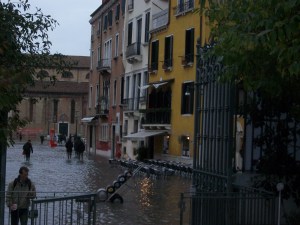
Acqua Alta. After the loss of a friend in 2009, I took a long look at my list. In that very moment, I stopped and bought tickets for a winter journey to Venice in hopes of experiencing something that had always fascinated me – the high water phenomenon in Venice. If not now, when?

Setting off on a trip with a clear focus is the best kind of selfish. I would not put anyone else through the reality that Venetian majesty might well be dimmed with fog, rain and chill. And 2 feet of water. That we’d be substituting a cozy dark bar with port for the sunny Lido.  The trip circled around what intrigues me and me alone.Flood Behind Inst. of Letters

It was a singular type of adventure – everything from the date (full moon, winter) to the hotel (great public spaces) and to the space in my luggage for my new Wellington boots – was structured around a behind the scenes look at Venice and the winter high water.

So, I left the week of my birthday and arrived on a cloudy Sunday, with a certainty of why I was here in a city stringing its Christmas lights, buttoning its jacket, turning inward.

It was a trip built on chance but it all happened. On my first morning, I awoke to the high water alarms and through my window watched the water overtake the hotel pier. (It was worth every cubic inch of suitcase space those boots required.)

It was everything I hoped, seeing behind the tourist veil to how Venetians live in a city on stilts, walking with grandmothers across temporary plywood risers to cross the square, standing in a foot of water waiting for my morning coffee with office workers, and seeing the dignified staff of the Europa & Regina clearing the marble hall of water before other guests descended! I saw and learned so much but after that morning, after the flood, I was off the clock. The rest of the glorious week had earned its spontaneity and ease. I had seen what I came to see and now each day was an open ticket.

For 2014, it was Iceland and the Aurora Borealis. It was a long shot – in deep winter, in Iceland, in 5 hours of daylight. Putting myself in the path of possibility.

What is still on the list? What must I do on my own? What would a partner never understand? What will I regret if I wake up one morning unable to go on such a trip?

What are we hoping for – in our travel, our hobbies, our loves? For me, it may be completeness. What will I resolve, put to rest, fulfill? What will add up to a life well-lived when I face the unexpected end?

I hope that by the end of my time on the planet I become wise, whole, kind and loving with a sense of humour and surprise. And I want to have reached out for all the planet wanted to show me.

Where are you going?

What I Learned

  1. Having a single goal, something you feel passion around, gives a sense of purpose, priority and structure to a trip on your own.
  2. Picking a hotel with great public spaces is a valuable investment. You need a place around people where you can read, email and watch the parade of life.
  3. The hotel staff is your home team. Let them know why you’ve come and what you hope to experience. A clear and passionate purpose can be irresistible and you may find unexpected help.


The First Night or 3 Things to Do with That Sense of Impending Doom

I love the adventure of starting a trip – from the cup of coffee at your home airport to arrival and that first walk through town.  But the first night can be tricky. I didn’t see the pattern until solo trip #3. You arrive sleep deprived. You’re in a strange city without the energy to embrace it…yet. There is a lot to learn and everything is a little hard.  For me, this creates some emotional mayhem.

Once I’ve awakened in a new country, all my gauges reset…I’m grounded by having slept and then risen in this new place and all its possibilities.  Not the first night. That’s when my mind is full of worry and wild thoughts of everything that could be going wrong at home right that minute.  Then here? What was I thinking to come here – what if I need help, can’t find my way in a new city or get completely lost.  (In the morning the answers are clear – ask the front desk, call a cab,  follow the crowd.)

None of this helps the first night. What do you do with your sense of impending doom? A good friend of mine – who is independent and brave – didn’t expect this rush of doubt and was so thrown she cut her trip short.

Everyone is different but I have two thoughts for fellow travelers.  First, if you expect it and can name what’s happening, you are equipped.  I learned a lesson inVenice.  My Dad’s health wasn’t great that winter.  On my first evening, I realized I had not gotten an email from home.  I convinced myself his health had taken a turn and no one was telling me.  I paid 25 euros in the middle of the night through the hotel TV for on screen web service to check my email again and again and to send a couple of half-crazy messages home. Seriously, by the time I awakened the first morning, I was sure that I shouldn’t unpack.

(I was also concerned that the national debt was spiraling, that the birthday I was celebrating that week was the beginning of the end and was a little undone by the cancellation of Studio 60 on the Sunset Strip. This stuff defies logic.)

Here is the second thing I learned. Embrace it. I got out of bed and made some tea and sat across the table from my nightmare. By embracing, I mean I tried to look closely and examine what I feared.  I was much more worried about Dad than I had ever realized at home and here, in a strange place, it was all rushing to the surface. Maybe I was afraid that I didn’t know enough about his health. Did I need to have some important conversations?  And I definitely wanted to spend more time with him at home. There were other worries about decisions I was making and I started to write some of this down in my trip book. I knew a little more about what was going on in my head and heart.

So what do you do in the morning? I tried something hyper-rational that worked for me. I embraced one of those fears – that something at home might be going wrong and that, though all was well today, there was the possibility of being called home early.

So – if I only had a day in Venice, what would I do?  I started prioritizing my list.  If I had one day, I wanted to visit Murano and buy some gifts I’d promised to bring home. I wanted to ride the #1 vaporetta the entire length of the Grand Canal at sunset and I wanted to eat at my favorite restaurant. Trying to figure out fear, anxiety and the whole week was too big an order but I could plan this first day.

By the time I’d worked my list that day, my head and heart were back in order. The push to get my short list accomplished nudged me over bumps in the road – I learned again how to read the vaporetta map, I made some decisions, I conquered the must-have shopping, and pushed myself to enjoy a very special event like dinner at the Saturnia International.

OK, I also gave up and called home. Everything was fine. Why, they asked, are you calling here??  It’s expensive, you’re on vacation, we’re fine, and did you buy the Christmas gifts?  The world slipped back into place pretty quickly.

In the end, my dad was gone two months later. Having taken a trip didn’t make the loss easier and it didn’t make me appreciate him more.  I had spent a lifetime knowing who he was and how lucky I am.  I did go home with a clearer look inside my heart, acknowledging fears and questions I’d tucked away and it made a difference.